Among the many competitive and unforgettable moments, one remains forever linked to the Rally de Portugal: the legendary Fafe jump by Armin Schwarz in 2000.
Launched in 1999, the Octavia WRC marked the Czech manufacturer’s entry into the modern era of World Rally Cars. Based on the road-going Octavia, it stood out for its generous dimensions and the robustness that proved valuable in demanding rallies such as Safari and Acropolis.
One of the drivers associated with the project was Armin Schwarz, an experienced German who contributed to the car’s development. On the Fafe stage, during the 2000 Rally de Portugal, Schwarz sent the Octavia WRC into a spectacular leap that quickly went around the world. The image of the car fully airborne, with thousands of fans as a backdrop, became a symbol of drivers’ bravery and of the spectacle of the Portuguese rally. More than the distance covered, the moment stood out for the way it combined speed, control and visual impact. The Octavia, large and heavy by the standards of the time, seemed to defy physics as it flew with remarkable stability. For many fans, that moment still represents the essence of Fafe: a perfect balance between risk and spectacle.
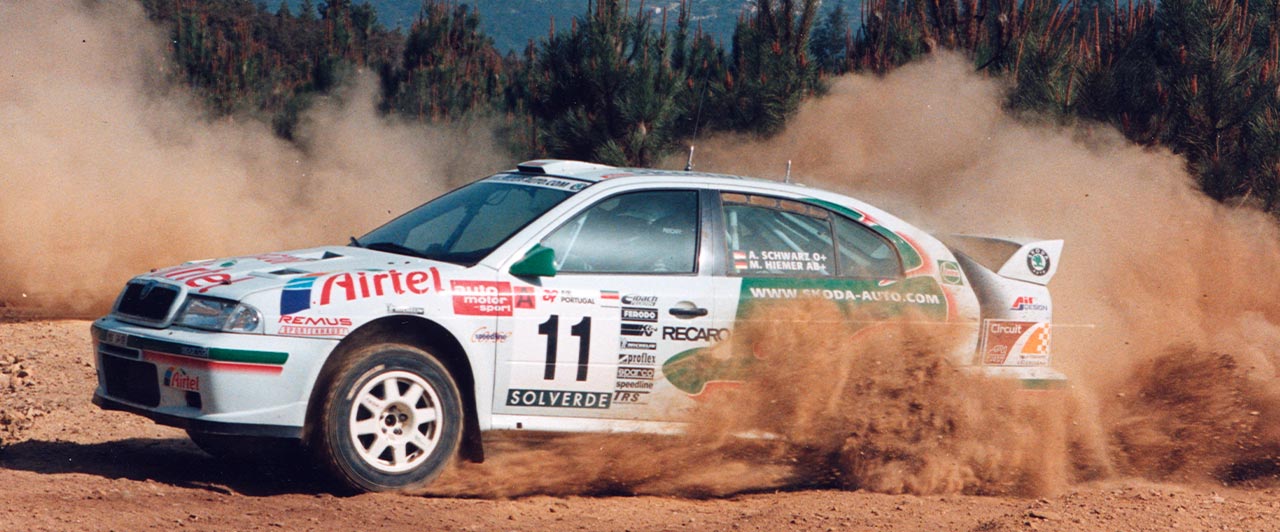
Years later, Schwarz’s jump would often be compared to that of Mads Østberg, who also produced a memorable leap in Fafe at the wheel of modern machinery. The Norwegian’s images rivalled in popularity and reignited the debate among fans over which jump was the most impressive.
Armin Schwarz’s flight in 2000 was not just a great jump — it was a historic moment that immortalised the Škoda Octavia WRC and reinforced Fafe’s legend as one of the most iconic stages in world motorsport.